Today, the U.S. Department of the Treasury’s Office of Foreign Assets Control (OFAC) sanctioned Transnational Criminal Organization (TCO) Xinbi Guarantee, a Chinese-language platform used extensively by Chinese cybercriminals that operates a large illicit online marketplace used to support cyber scams, fraud, money laundering, and other criminal activity targeting Americans. OFAC also designated two entities that support Xinbi Guarantee’s core operations via the provision of digital currency and other financial services. This action is being taken in coordination with the Department of Justice’s Scam Center Strike Force (SCSF), which today seized infrastructure and digital asset wallets used by Xinbi Guarantee.
“Scam centers in Southeast Asia steal billions of dollars from American victims each year,” said Secretary of the Treasury Scott Bessent. “The Trump Administration is united in its efforts to dismantle these overseas criminal enterprises, and Treasury will continue using its tools to disrupt the networks behind this egregious fraud and protect Americans.”
These actions are being taken in furtherance of President Trump’s Executive Order (E.O.) 14390 of March 6, 2026, “Combating Cybercrime, Fraud, and Predatory Schemes Against American Citizens,” which orders the U.S. Government to unleash every available tool to stop foreign-backed criminal networks that exploit vulnerable Americans through cybercrime, cyber-enabled fraud, and extortion. Today’s action further reflects OFAC’s coordination with the Homeland Security Task Force and National Coordination Center.
Today’s designations build on OFAC’s designations of the Prince Group Transnational Criminal Organization (Prince Group TCO) and persons related to the Prince Group TCO in October 2025 and June 23, 2026, and Treasury’s Financial Crimes Enforcement Network (FinCEN)’s October 2025 Huione Group section 311 final rule and subsequent June 2026 proposed amendment. Specifically, this action aims to build on efforts by Treasury to identify illicit marketplaces and highlight the risks they pose through their money laundering activities.
Additionally, this action highlights close cooperation between the United States and the United Kingdom to counter scam operations. OFAC’s actions today complement the United Kingdom’s Foreign, Commonwealth, and Development Office’s (FCDO) March 26, 2026 sanctions action against Xinbi.
OFAC is taking today’s action pursuant to E.O. 13581 (“Blocking Property of Transnational Criminal Organizations”), as amended by E.O. 13863 (“E.O. 13581, as amended”).
TRANSNATIONAL CRIMINAL ORGANIZATIONS BEHIND LARGE SCALE SCAMS
Transnational criminal organizations increasingly rely on interconnected networks of online marketplaces, payment institutions, virtual asset service providers, and money laundering facilitators to conduct cyber scams and move stolen funds.
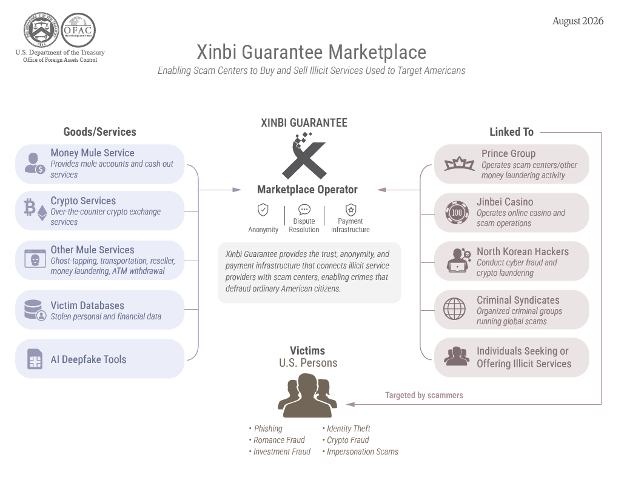
Xinbi Guarantee operates an illicit online marketplace that serves as a central node connecting transnational criminal syndicates, including scam center operators, with merchants that provide financial services, technology, and other goods that support their criminal operations. Xinbi’s platform is used by scam center operators to purchase goods and facilitate transactions in support of cyberscam and cybercrime operations, including various types of financial fraud. Xinbi Guarantee provides scam operators, money laundering networks, and cybercrime syndicates with escrow services through its platform. Xinbi Guarantee’s platform has reportedly been used by North Korean hackers and by several OFAC designated entities, including Jin Bei Group Co., Ltd. and entities that are part of the Prince Group TCO.
Since its inception around 2022, Xinbi Guarantee’s marketplace has processed the equivalent of over $24 billion in digital assets and fiat currency through its marketplace and via its platforms, primarily facilitating transactions in countries located in Southeast Asia. Following FinCEN’s listing of Huione Pay, a financial services conglomerate of primary money laundering concern, cybercriminals attempted to preserve their operations by transferring their activities to Xinbi Guarantee’s marketplace, which has continued offering substantially similar services to an overlapping customer base.
KEY ENABLERS OF XINBI GUARANTEE
OFAC is also taking action against Southeast Asia-based application development companies responsible for providing applications that support Xinbi Guarantee’s illicit operations. Specifically, in response to growing law enforcement scrutiny, around June 2025, Xinbi Guarantee began migrating its merchant and money-laundering networks to SafeW, a highly private, end-to-end encryption messaging application developed by Singapore-based SafeW Technology Co., Ltd. (SafeW Technology). Xinbi Guarantee encourages its users to use SafeW as a coordination platform for buyers and sellers. At the same time, Xinbi Guarantee launched XinbiPay, also referred to as NewPay wallet, a cryptocurrency payment and digital wallet application developed by Cambodia-based Anwen Technology Co., Ltd (Anwen).
Xinbi Guarantee is being designated pursuant to E.O. 13581, as amended, for being a foreign person that constitutes a significant transnational criminal organization.
Anwen and SafeW Technology are being designated pursuant to E.O. 13581, as amended, for having materially assisted, sponsored, or provided financial, material, or technological support for, or goods or services to or in support of, Xinbi Guarantee.
SANCTIONS IMPLICATIONS
As a result of today’s action, all property and interests in property of the designated persons described above that are in the United States or in the possession or control of U.S. persons are blocked and must be reported to OFAC. In addition, any entities that are owned, directly or indirectly, individually or in the aggregate, 50 percent or more by one or more blocked persons are also blocked. Unless authorized by a general or specific license issued by OFAC, or exempt, OFAC’s regulations generally prohibit all transactions by U.S. persons or within (or transiting) the United States that involve any property or interests in property of designated or otherwise blocked persons.
Violations of U.S. sanctions may result in the imposition of civil or criminal penalties on U.S. and foreign persons. OFAC may impose civil penalties for sanctions violations on a strict liability basis. OFAC’s Economic Sanctions Enforcement Guidelines provide more information regarding OFAC’s enforcement of U.S. economic sanctions. In addition, financial institutions and other persons may risk exposure to sanctions for engaging in certain transactions or activities involving designated or otherwise blocked persons. The prohibitions include the making of any contribution or provision of funds, goods, or services by, to, or for the benefit of any designated or blocked person, or the receipt of any contribution or provision of funds, goods, or services from any such person. Non-U.S. persons are also prohibited from causing or conspiring to cause U.S. persons to wittingly or unwittingly violate U.S. sanctions, as well as engaging in conduct that evades U.S. sanctions. Individuals located in the U.S. or abroad who provide information about sanctions violations to FinCEN’s whistleblower incentive program may be eligible for awards if the information they provide leads to a successful enforcement action that results in monetary penalties exceeding $1,000,000.