India- and Latin America-Based Entities Provided Precursor Chemicals to Terrorist Cartel
WASHINGTON-Today, the U.S. Department of the Treasury’s Office of Foreign Assets Control (OFAC) sanctioned 23 individuals and entities that comprise a sophisticated synthetic opioid procurement network with ties to the Sinaloa Cartel, a designated Foreign Terrorist Organization. Chemical suppliers and brokers, including those designated today, have reshaped the narcotics landscape by enabling Mexican cartels to synthesize illicit drugs from precursor chemicals primarily imported from Asia. By exploiting international supply chains and clandestine production facilities, these networks manufacture highly potent and dangerous synthetic opioids more efficiently than ever before. These illicit drugs, including fentanyl and methamphetamine, ultimately reach the streets of American cities and kill tens of thousands of Americans each year. Today’s designations target every stage of the synthetic opioid supply chain.
“President Trump has been clear that terrorist cartels will not be allowed to wreak havoc on our borders and in our communities,” said Secretary of the Treasury Scott Bessent. “Treasury will continue to target every stage of the opioid supply chain to Keep America Safe and prevent more lives lost to fentanyl.”
Today’s action reflects a unified, whole-of-government effort to ensure operational coordination and maximize impact against transnational criminal networks. A parallel criminal action is the culmination of a coordinated investigation led by the Homeland Security Task Force (HSTF), with support from the Drug Enforcement Administration and its Special Operations Division; the Federal Bureau of Investigation; Homeland Security Investigations; U.S. Customs and Border Protection; various foreign law enforcement counterparts; and Treasury’s Financial Crimes Enforcement Network (FinCEN). OFAC continues to work closely with the HSTF to disrupt the flow of illicit drugs and dismantle the networks, facilitators, and financial infrastructure that enable their production and distribution.
These designations were issued pursuant to Executive Order (E.O.) 14059, which targets the international proliferation of illicit drugs and their means of production, and pursuant to E.O. 13224, as amended, which targets terrorists and their supporters.
Today’s action is also taken in furtherance of E.O. 14367, which designated fentanyl and its core precursor chemicals as Weapons of Mass Destruction (WMDs). The lethality of illicit fentanyl, its manufacture and distribution by organized criminal networks, and its role as a source of revenue for violent cartels, makes it an imminent national security threat to the United States. Treasury is committed to using all tools at its disposal to disrupt the manufacture and trafficking of fentanyl.
FROM CHEMICAL LABORATORIES TO ILLICIT MARKETS – FENTANYL AND METHAMPHETAMINE PRODUCTION
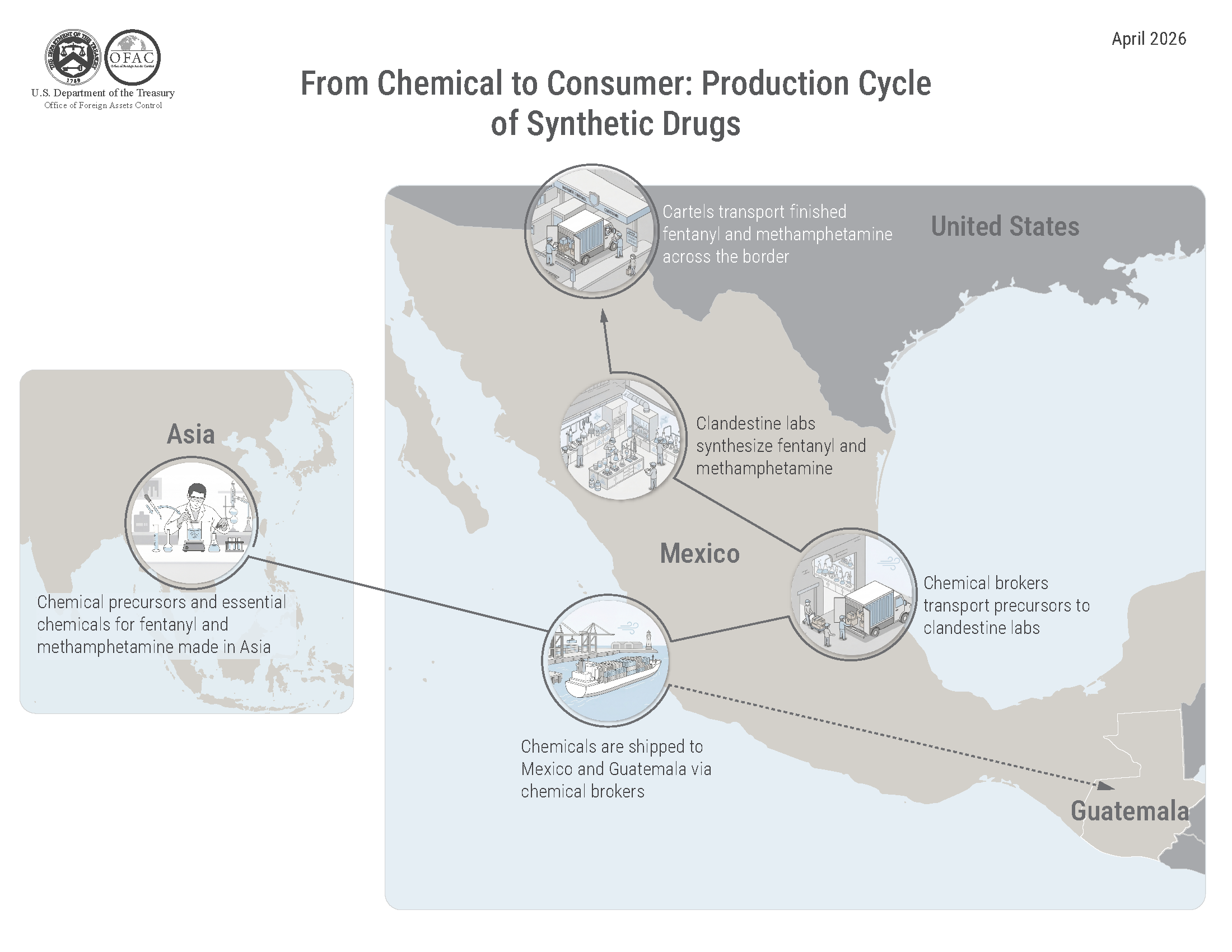
Mexican cartels rely on chemical companies throughout the world to supply the precursors and other essential chemicals necessary to produce synthetic opioids. These chemical suppliers are predominantly located in Asia, where they market and sell fentanyl precursors such as 4-Piperidone, N-Boc-4-Piperidone, and other related derivatives online to brokers by the kilogram. Per U.S. Department of Justice estimates, one kilogram of the precursor N-Boc-4-Piperidone yields around 1.83 kilograms of fentanyl, a volume with the potential to yield around 900,000 lethal doses.
The brokers, acting in tandem with Mexican cartels, facilitate the logistics and shipping of these chemicals to Mexico or Guatemala via air or maritime cargo. Often, shipments containing kilograms of deadly fentanyl precursors are mislabeled as “safe chemicals.” The brokers then transfer the chemicals to individuals known as “cooks,” who control clandestine synthetic drug laboratories controlled by cartels.
One of these cartels is the Sinaloa Cartel, a Foreign Terrorist Organization and one of the largest producers of fentanyl and other illicit drugs bound for the United States. For decades, the Sinaloa Cartel has flooded the United States with fentanyl, methamphetamine, cocaine, heroin, and other illicit drugs. The Sinaloa Cartel, one of the world’s most powerful drug cartels, operates extensive transnational networks to facilitate the procurement of precursor chemicals from Asia to synthesize into fentanyl and other synthetic drugs in its Mexico-based clandestine labs.
DISRUPTING THE SUPPLY – INDIA-BASED PRECURSOR SOURCES

Today, OFAC designated Satishkumar Hareshbhai Sutaria (Sutaria), an India-based pharmaceutical chemicals supplier trading in fentanyl precursors for use in the production of illicit fentanyl. With salesperson Yuktakumari Ashishkumar Modi (Modi), Sutaria facilitates sales and shipments of these precursors to Mexico and Guatemala, including N-Boc-4-Piperidone, and mislabels them as “safe chemicals.” Sutaria and Modi have used SR Chemicals and Pharmaceuticals (SR Chemicals) and Agrat Chemicals and Pharmaceuticals (Agrat Chemicals), both India-based pharmaceutical chemical companies, to conduct these transactions. Sutaria and Modi were arrested in March 2025 by Indian authorities for this activity.
OFAC designated Sutaria, Modi, SR Chemicals, and Agrat Chemicals pursuant to E.O. 14059 for having engaged in, or attempted to engage in, activities or transactions that have materially contributed to, or pose a significant risk of materially contributing to, the international proliferation of illicit drugs or their means of production.
CUTTING OUT THE MIDDLEMEN – LATIN AMERICA-BASED BROKERS AND IMPORT/EXPORTERS

Today, OFAC designated Jaime Augusto Barrientos Camaz (Barrientos), a Guatemala-based broker of fentanyl precursors who sources his supply from various companies in India, including Agrat Chemicals and SR Chemicals. Utilizing the Guatemala City-based business J and C Import, Barrientos was the end recipient of N-Boc-4-Piperidone totaling 116 kilograms over a two-month period.
Central Logistica de Servicios (Central) is another Guatemala-based import/export company involved in shipping fentanyl precursors, as well as finished fentanyl.
OFAC designated Barrientos, J and C Import, and Central pursuant to E.O. 14059 for having engaged in, or attempted to engage in, activities or transactions that have materially contributed to, or pose a significant risk of materially contributing to, the international proliferation of illicit drugs or their means of production.

Karina Guadalupe Carrillo Torres (Carrillo) is a Sinaloa, Mexico-based broker of fentanyl precursor chemicals. Carrillo has been linked to multiple seizures of 1-Boc-4-Hydroxypiperidine totaling over 50 kg. Carrillo reportedly has familial connections to the Chapitos faction of the Sinaloa Cartel and is the wife of Sinaloa Cartel member Regulo Acosta Hernandez (Acosta), whom OFAC also designated today.
Acosta is a Sinaloa, Mexico-based fentanyl and cocaine supplier. Acosta has utilized money launderers within the United States to receive drug payments. Together, Carrillo and Acosta own the companies Desarrollos Cartok S.A. de C.V. (Cartok) and Comercializadora Grupo Carhern S.A. de C.V. (Carhern). Both Carrillo and Acosta were arrested in Mexico in March 2026 for drug-related offenses.
OFAC designated Carrillo and Acosta pursuant to E.O. 14059 for having engaged in, or attempted to engage in, activities or transactions that have materially contributed to, or pose a significant risk of materially contributing to, the international proliferation of illicit drugs or their means of production. OFAC designated Cartok and Carhern pursuant to E.O. 14059 for being owned, controlled, or directed by, or having acted or purported to act for or on behalf of, directly or indirectly, Carrillo.
Maria Viridiana Rugerio Arriaga (Rugerio) is a broker for chemical precursors located in Mexico. Rugerio purchases chemicals from India and sells them to drug producers to synthesize into fentanyl and methamphetamine. Rugerio has acted as a broker for precursors and other essential chemicals used in the production of fentanyl and methamphetamine, including N-Boc-4-Piperidone. Rugerio owns the Leon, Guanajuato, Mexico-based company Quimica Soluciones y Logistica Internal Bajio, S.A. de C.V. (Quimica).
OFAC designated Rugerio pursuant to E.O. 14059 for having engaged in, or attempted to engage in, activities or transactions that have materially contributed to, or pose a significant risk of materially contributing to, the international proliferation of illicit drugs or their means of production. OFAC designated Quimica pursuant to E.O. 14059 for being owned, controlled, or directed by, or having acted or purported to act for or on behalf of, directly or indirectly, Rugerio.
Jose de Jesus Ramirez Torres (Ramirez) is a Jalisco, Mexico-based importer who uses his companies, including Corporativo y Enlace Ram S.A. de C.V. (Enlace Ram), to import methamphetamine precursor chemicals to Mexico. Ramirez Torres’ corporate network also includes Mexico-based entities Enlace Forwarding Mexico, S. de R.L. de C.V. (Enlace Forwarding) and Cargo Global 3PS, S. de R.L. de C.V. (Cargo Global), and Florida-based entity E-Ram Group LLC (E-Ram).
OFAC designated Ramirez Torres pursuant to E.O. 14059 for having engaged in, or attempted to engage in, activities or transactions that have materially contributed to, or pose a significant risk of materially contributing to, the international proliferation of illicit drugs or their means of production. OFAC designated Enlace Ram, Enlace Forwarding, and Cargo Global pursuant to E.O. 14059 for being owned, controlled, or directed by, or having acted or purported to act for or on behalf of, directly or indirectly, Ramirez Torres. OFAC identified E-Ram as blocked property, as Ramirez Torres, a person whose property and interest in property are blocked pursuant to E.O. 14059, has an interest in the property.
Reyma Global Trading S.A. de C.V. (Reyma) is a Mexico City, Mexico-based importer that has imported large quantities of chemicals known to be used in the production of methamphetamine for various organizations, including the Sinaloa Cartel. Aduaeasy S. de R.L. de C.V. (Aduaeasy) is a Mexico-based importer of chemicals known to be utilized in methamphetamine production that has received shipments of chemicals from Asia.
OFAC designated Reyma and Aduaeasy pursuant to E.O. 14059 for having engaged in, or attempted to engage in, activities or transactions that have materially contributed to, or pose a significant risk of materially contributing to, the international proliferation of illicit drugs or their means of production.
THE LAST LINK – CARTEL-AFFILIATED DRUG TRAFFICKERS
As part of this sprawling illicit opioid network, OFAC also designated two Sinaloa Cartel-affiliated individuals, including Ramiro Baltazar Felix Heras (Felix). Felix is a high-ranking member of the Los Mayos faction of the Sinaloa Cartel who is involved in smuggling fentanyl and methamphetamines into the United States.
Alejandro Reynoso Jimenez (Reynoso) is a chemist and operator of clandestine labs in Guadalajara, Jalisco, Mexico that obtained and utilized precursor chemicals for the production of fentanyl for the Sinaloa Cartel, specifically for the Los Chapitos faction. Utilizing his pharmacy Botanica 2000 in Guadalajara, Reynoso produced fentanyl-laced pills to be shipped to the United States. Reynoso was arrested in Madrid, Spain in November 2025.

OFAC designated Felix and Reynoso pursuant to E.O. 14059 and E.O. 13224, as amended, for being owned, controlled, or directed by, or having acted or purported to act for or on behalf of, directly or indirectly, the Sinaloa Cartel. OFAC designated Botanica 2000 pursuant to E.O. 14059 and E.O. 13224, as amended, for being owned, controlled, or directed by, or having acted or purported to act for or on behalf of, directly or indirectly, Reynoso.
SANCTIONS IMPLICATIONS
As a result of today’s action, all property and interests in property of the designated or blocked persons described above that are in the United States or in the possession or control of U.S. persons are blocked and must be reported to OFAC. In addition, any entities that are owned, directly or indirectly, individually or in the aggregate, 50 percent or more by one or more blocked persons are also blocked. Unless authorized by a general or specific license issued by OFAC, or exempt, OFAC’s regulations generally prohibit all transactions by U.S. persons or within (or transiting) the United States that involve any property or interests in property of blocked persons.
Violations of U.S. sanctions may result in the imposition of civil or criminal penalties on U.S. and foreign persons. OFAC may impose civil penalties for sanctions violations on a strict liability basis. OFAC’s Economic Sanctions Enforcement Guidelines provide more information regarding OFAC’s enforcement of U.S. economic sanctions. In addition, financial institutions and other persons may risk exposure to sanctions for engaging in certain transactions or activities involving designated or otherwise blocked persons. The prohibitions include the making of any contribution or provision of funds, goods, or services by, to, or for the benefit of any designated or blocked person, or the receipt of any contribution or provision of funds, goods, or services from any such person. Non-U.S. persons are also prohibited from causing or conspiring to cause U.S. persons to wittingly or unwittingly violate U.S. sanctions, as well as engaging in conduct that evades U.S. sanctions. Individuals located in the U.S. or abroad who provide information about sanctions violations to FinCEN’s whistleblower incentive program may be eligible for awards if the information they provide leads to a successful enforcement action that results in monetary penalties exceeding $1,000,000. FinCEN is currently accepting whistleblower tips here.
Furthermore, engaging in certain transactions involving the persons designated today may risk the imposition of secondary sanctions on participating foreign financial institutions. OFAC can prohibit or impose strict conditions on opening or maintaining, in the United States, a correspondent account or a payable-through account of a foreign financial institution that knowingly conducts or facilitates any significant transaction on behalf of a person who is designated pursuant to the relevant authority.