Today, the U.S. Department of the Treasury’s Office of Foreign Assets Control (OFAC) designated 15 Ecuador-based targets and identified as blocked property 10 vessels involved in covertly shipping thousands of kilograms of cocaine each month from South America to Mexico, destined for distribution in the United States. Members of the network targeted today are affiliated with Los Choneros and Los Lobos, which are two of Ecuador’s most violent Foreign Terrorist Organizations (FTOs) and maintain ties to Mexican FTOs.
“Under President Trump’s leadership, Treasury is relentlessly targeting the narcoterrorist networks that profit from poisoning Americans,” said Secretary of the Treasury Scott Bessent. “Working alongside our law enforcement partners, we will continue to disrupt the cartels’ drug trafficking operations and protect our borders.”
Operating under the guise of legitimate fishing businesses, a fleet of Ecuador-based vessels near Manta, Ecuador, secretly transfers cocaine to small power boats-known as go-fast vessels-that transit north through the Eastern Pacific Ocean (EPAC), en route to the United States. The cocaine is then smuggled through Mexico by FTOs like the Sinaloa Cartel and Cartel de Jalisco Nueva Generacion (CJNG).
Today’s designations target the deepening convergence between Ecuador and Mexico’s most violent FTOs, who conspire to ship deadly drugs into the United States and whose trafficking operations generate billions of dollars annually for narcoterrorists.
In keeping with President Trump’s pledge to eliminate drug cartels, OFAC has prioritized targeting these and other criminal groups that threaten the welfare of Americans in close coordination with the Homeland Security Task Force, taking nearly 30 actions against over 300 individuals and entities since the beginning of 2025. OFAC uses a network-based approach to simultaneously disrupt as many different facets of the cartels as possible, from their leadership and key organizational nodes to facilitators and enablers, such as corrupt officials, complicit family members, and ostensibly legitimate front persons.
Today’s action reflects a unified, whole-of-government effort to ensure operational coordination and maximize impact against transnational criminal networks. This action reflects the culmination of coordinated efforts related to interdicting narcotics in the EPAC, including investigations led by the Homeland Security Task Force-Tampa, and builds on extensive investigative support from Joint Interagency Task Force-South and the Drug Enforcement Administration, as well as from the Florida National Guard Counterdrug Program, the Department of War’s U.S. Southern Command, the Office of Naval Intelligence, and the Department of Homeland Security’s U.S. Coast Guard.
OPERATION PACIFIC VIPER
Treasury’s action today is a part of a larger U.S. government effort to target drug trafficking in the EPAC, a primary transit corridor for smuggling from South and Central America via Mexico to the United States. In August 2025, the U.S. Coast Guard launched Operation Pacific Viper, an accelerated counter-drug campaign in the EPAC. As part of this operation, the Coast Guard has surged cutters, aircraft, and tactical teams to interdict, seize, and disrupt the flow of cocaine and other illicit drugs. As of June 2026, Operation Pacific Viper has seized more than 225,000 pounds (approximately 112 tons) of cocaine in the EPAC.
OFAC’s sanctions today expose ostensibly legitimate fishing businesses who use their commercial cover to support narcoterrorist networks. These sanctions complement U.S. government efforts to disrupt these networks and align with the strategic goal of imposing comprehensive systemic friction on narcoterrorist networks in the Western Hemisphere, and the broader lines of effort to illuminate, disrupt, and degrade narcoterrorism threat networks in the EPAC region.
CONVERGENCE OF ECUADOR-BASED TERRORIST GROUPS AND MEXICAN CARTELS
Los Choneros is one of Ecuador’s most violent criminal organizations which, through its partnership with the Sinaloa Cartel and other Mexican cartels, has managed to control key cocaine trafficking routes from South America through Mexico and into the United States. From Los Choneros evolved a splinter Ecuador-based group known as Los Lobos, which is believed to have established drug routes from South America into Mexico through the group’s connections with violent cartels like CJNG. On November 16, 2025, the leader of Los Lobos, Wilmer Chavarria, alias “Pipo,” was arrested in Spain.
On September 4, 2025, the Department of State designated Los Choneros and Los Lobos, respectively, as FTOs and Specially Designated Global Terrorists (SDGTs). Treasury previously sanctioned Los Choneros on February 7, 2024, and Los Lobos on June 6, 2024, respectively, pursuant to Executive Order (E.O.) 14059, which targets the international proliferation of illicit drugs and their means of production. On February 20, 2025, the Department of State designated CJNG as an FTO and SDGT. Treasury previously sanctioned CJNG on April 8, 2015 pursuant to the Foreign Narcotics Kingpin Designation Act and on December 15, 2021 pursuant to E.O. 14059.
COCAINE: A PROFITABLE REVENUE STREAM FOR CARTELS
International cocaine trafficking remains a serious threat to the United States, as the substantial profits generated from these sales continue to fund and strengthen Mexican cartel operations. For decades, South America has been the origin of global cocaine production, with the Caribbean and EPAC serving as the primary transit routes for the shipment of narcotics from South America to the United States. According to the 2026 National Southwest Border Counternarcotics Strategy, the production of plant-based drugs, like cocaine, is emerging out of South America at record-high levels. Likewise, Ecuador’s fishing industry has become increasingly susceptible to criminal and terrorist exploitation as cartel networks establish cocaine transportation routes off the coast of Manta, Ecuador, through the EPAC, to Mexico. While Ecuador recently emerged as the leading launchpad for cocaine shipments, Mexican cartels have been involved in cocaine trafficking for decades and are the primary suppliers of cocaine and other narcotics to the United States. With Mexico as the primary destination for drugs leaving Ecuador, it is estimated that cocaine trafficking produces billions in revenue for cartels annually.
CRIMINALS EXPLOITING ECUADOR’S FISHING INDUSTRY
Treasury’s action today highlights the surreptitious means that narcoterrorist organizations use to conduct drug trafficking throughout the Western Hemisphere.
Utilizing a network of fishing vessels operated by the family business, Arcasdenoe, S.A., Alfonso Mero Mero and his sons, Roberth Alfonso Mero Arcentales (Roberth Mero Arcentales) and Edwar Alexis Mero Arcentales (Edwar Mero Arcentales), are responsible for smuggling thousands of kilograms of cocaine from South America to Mexico and provide refueling services to go-fast vessels used to transport cocaine across the EPAC. Along the trafficking route, these fishing vessels, using government-subsidized fuel, provide refueling, food, and medical services to cocaine-laden vessels at coordinated locations along the EPAC to ensure their successful passage to Mexico. In addition, Edwar Mero Arcentales engages in narcotics trafficking activities in coordination with Los Choneros.
Other fishing vessel operators include Julio Javier Mero Franco (Julio Mero Franco), who supports Los Choneros and has coordinated the transport of approximately 30-40 tons of cocaine a month from Ecuador to Central America and Mexico. Milton Edixon Martinez Mendoza (Martinez Mendoza) supports Los Lobos and Los Choneros and has coordinated the transport of thousands of kilos of cocaine via go-fast vessels en route to Mexico. Jhonny Francisco Vera Laz (Vera Laz) operates on behalf of Julio Mero Franco and has trafficked thousands of kilograms of cocaine a month from the coastline of Ecuador to Mexico. Byron Aldino Mero Bermello (Mero Bermello) has been involved in cocaine trafficking and, along with Jimmy Leonidas Alarcon Holguin (Alarcon Holguin), is responsible for coordinating the refueling of the cocaine-laden vessels en route to Mexico. Alarcon Holguin owns or controls six entities based in Ecuador: Alho Fish, S.A., Globaldistrial, S.A.S., JAH-HMH, S.A.S., Negocios Jimar, S.A.S., Proyectos Neyzoa S.A.S., and Soisamar, S.A.S. With the exception of Globaldistrial, S.A.S., all entities are involved in marine fishing. Globaldistrial, S.A.S. is involved in the trade of construction materials.
Todos Vuelven (Todos), Arca De Noe III (Arca III), Arca De Noe III Jr (Arca III Jr), Arca De Noe IV (Arca IV), Arca De Noe V (Arca V), Conquista, Siempre Mi Arca (Siempre), Rey De Arca (Rey), Costa Marlin (Costa) and Solo Es Mejor (Solo) are Ecuador-based fishing vessels that provide logistical support to go-fast vessels transporting cocaine across the EPAC by providing fuel, food, and medical services, as well as detecting and monitoring for law enforcement vessels. In addition to its logistics role, Todos also transports multi-ton quantities of cocaine.
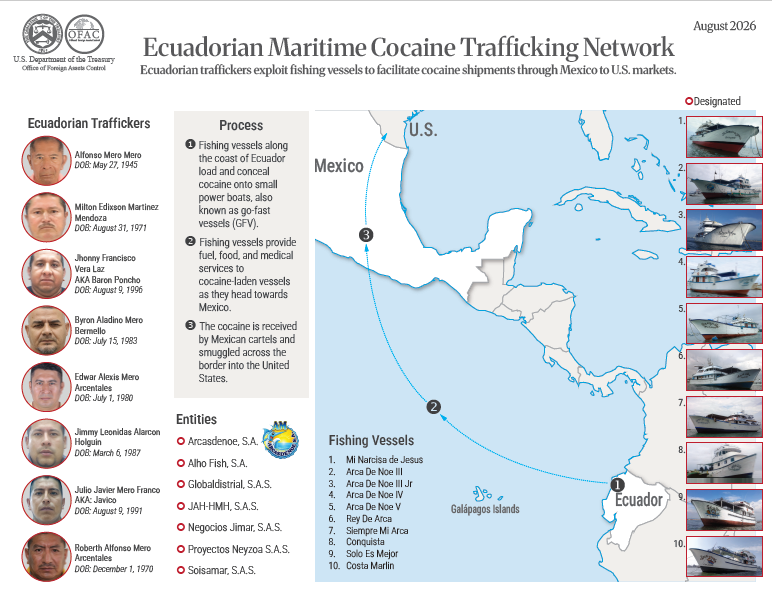
OFAC designated Alfonso Mero Mero, Edwar Mero Arcentales, Roberth Mero Arcentales, Alarcon Holguin, and Mero Bermello, pursuant to E.O. 14059 for having engaged in, or attempted to engage in, activities or transactions that have materially contributed to, or pose a significant risk of materially contributing to, the international proliferation of illicit drugs or their means of production.
OFAC designated Julio Mero Franco and Martinez Mendoza pursuant to E.O. 14059 and E.O. 13224, as amended, for having provided, or attempted to provide, financial, material, or technological support for, or goods or services in support of, Los Choneros. OFAC also designated Martinez Mendoza pursuant to E.O. 14059 and E.O. 13224, as amended, for having provided, or attempted to provide, financial, material, or technological support for, or goods or services in support of, Los Lobos.
OFAC designated Vera Laz pursuant to E.O. 14059 and E.O. 13224, as amended, for being owned, controlled, or directed by, or having acted or purported to act for or on behalf of, directly or indirectly, Julio Mero Franco.
OFAC designated Arcasdenoe, S.A. pursuant to E.O. 14059 for being owned, controlled, or directed by, or having acted or purported to act for or on behalf of, directly or indirectly, Alfonso Mero Mero and Edwar Mero Arcentales. In addition, OFAC sanctioned Alho Fish, S.A., Globaldistrial, S.A.S., JAH-HMH, S.A.S., Negocios Jimar, S.A.S., Proyectos Neyzoa S.A.S., and Soisamar, S.A.S. pursuant to E.O. 14059 for being owned, controlled, or directed by, or having acted or purported to act for or on behalf of, directly or indirectly, Alarcon Holguin.
OFAC identified Todos, Arca III Jr, Arca V, Conquista, and Siempre as blocked property in the interest of Edwar Mero Arcentales. OFAC identified Arca III as blocked property in the interest of Roberth Mero Arcentales and Edwar Mero Arcentales. OFAC identified Arca IV and Rey as blocked property in the interest of Alfonso Mero Mero. OFAC identified Costa and Solo as blocked property in the interest of Alarcon Holguin.
SANCTIONS IMPLICATIONS
As a result of today’s action, all property and interests in property of the designated or blocked persons described above that are in the United States or in the possession or control of U.S. persons are blocked and must be reported to OFAC. In addition, any entities that are owned, directly or indirectly, individually or in the aggregate, 50 percent or more by one or more blocked persons are also blocked. Unless authorized by a general or specific license issued by OFAC, or exempt, OFAC’s regulations generally prohibit all transactions by U.S. persons or within (or transiting) the United States that involve any property or interests in property of designated or otherwise blocked persons.
Violations of U.S. sanctions may result in the imposition of civil or criminal penalties on U.S. and foreign persons. OFAC may impose civil penalties for sanctions violations on a strict liability basis. OFAC’s Economic Sanctions Enforcement Guidelines provide more information regarding OFAC’s enforcement of U.S. economic sanctions. In addition, financial institutions and other persons may risk exposure to sanctions for engaging in certain transactions or activities involving designated or otherwise blocked persons. The prohibitions include the making of any contribution or provision of funds, goods, or services by, to, or for the benefit of any designated or blocked person, or the receipt of any contribution or provision of funds, goods, or services from any such person. Non-U.S. persons are also prohibited from causing or conspiring to cause U.S. persons to wittingly or unwittingly violate U.S. sanctions, as well as engaging in conduct that evades U.S. sanctions. Individuals located in the United States or abroad who provide information about sanctions violations to the Financial Crimes Enforcement Network’s whistleblower incentive program may be eligible for awards if the information they provide leads to a successful enforcement action that results in monetary penalties exceeding $1,000,000.
Furthermore, engaging in certain transactions involving the persons designated pursuant to E.O. 13224, as amended, may risk the imposition of secondary sanctions on participating foreign financial institutions. OFAC can prohibit or impose strict conditions on opening or maintaining, in the United States, a correspondent account or a payable-through account of a foreign financial institution that knowingly conducts or facilitates any significant transaction on behalf of a person who is designated pursuant to the relevant authority.