
Long overdue re-org of FAA will also support modernization of our skies
WASHINGTON, D.C. – U.S. Transportation Secretary Sean P. Duffy and Federal Aviation Administration (FAA) Administrator Bryan Bedford today announced their plan to implement a long overdue overhaul of the FAA’s organizational structure.
The comprehensive re-organization – the largest in the agency’s history – includes the creation of a new safety oversight office. This office, which was supported by Congress in the 2024 FAA Reauthorization, will implement a single safety management system (SMS) and risk management strategy for the entire FAA. Now, instead of different safety metrics siloed in individual offices, the agency will be able to share safety data more freely. Other key changes include:
- Launching an Airspace Modernization office to ensure the installation of a brand-new air traffic control system moves at Trump Speed.
- Creating a new Advanced Aviation Technologies office to oversee the integration of drones, eVTOLs, and other advanced air mobility vehicles into the airspace.
- Shifting more key leadership posts to permanent positions.
- Consolidating the management of finance, IT, and human resource divisions under the administrator.
The restructuring will not result in reductions in force.
“Thanks to President Trump and Republicans in Congress, we received an unprecedented $12.5 billion down payment to modernize our skies,” said U.S. Transportation Secretary Sean P. Duffy. “But funding is only one piece of the puzzle. With these critical organizational changes, the FAA can streamline the bureaucracy, encourage innovation, and deliver a new air traffic control system at the speed of Trump – all while enhancing safety.”
“It’s important that we have the right people in the right places to do the best work possible,” said FAA Administrator Bryan Bedford. “These actions will put permanent leaders in place who embrace innovation, share safety data and insights freely and are focused on deploying a brand-new air traffic control system all while integrating key innovation technologies into the new National Airspace System (NAS).”
Additional Information:
The FAA’s new structure will be well positioned to implement Flight Plan 2026 , the agency-wide strategy that positions the FAA to meet aviation’s current challenges and future opportunities. The plan is built on three pillars: people, safety and NAS modernization. It reflects FAA’s commitment to strengthen our safety foundation, modernize the NAS, and invest in the people who make the FAA the global standard of aviation safety and efficiency.
The new organizational structure is below.
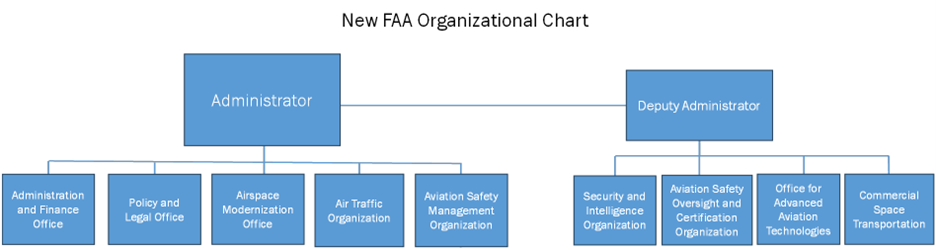
- The Administration and Finance Office-will include the following organizations: the Office of Finance and Management; the Office of Information and Technology; and the Office of Human Resource Management.
- The Policy and Legal Office-will oversee strategic policy, legal, stakeholder engagement, and financial assistance functions. It will also include the agency’s rulemaking and regulatory office, as authorized by the FAA Reauthorization Act of 2024.
- The Airspace Modernization Office-required by the FAA Reauthorization Act of 2024, the office will be responsible for modernizing the National Airspace System (NAS), including planning, research and development, systems engineering, and portfolio management.
- The Air Traffic Organization-will continue its mission providing the safest, most efficient air navigation services in the world.
- The Aviation Safety Management System (SMS) Organization-will lead an agency-wide safety management system by centralizing safety management activities previously conducted in five separate lines of business.
- The Office of Advanced Aviation Technologies-consistent with the FAA Reauthorization Act of 2024 and President Trump’s Executive Orders, the office will be the designated point for activities related to the integration of advanced aviation technologies including Advance Air Mobility, Unmanned Aircraft Systems, and Supersonic aircraft in United States.
- The Office of Commercial Space Transportation-will continue regulating the U.S. commercial space transportation industry.
- The Security and Intelligence Organization-will continue conducting security and intelligence activities.
- The Aviation Safety Oversight and Certification Organization-will continue the safety oversight and certification activities of the former Aviation Safety Organization.